

Editorial
The Ritual of Republican Resistance
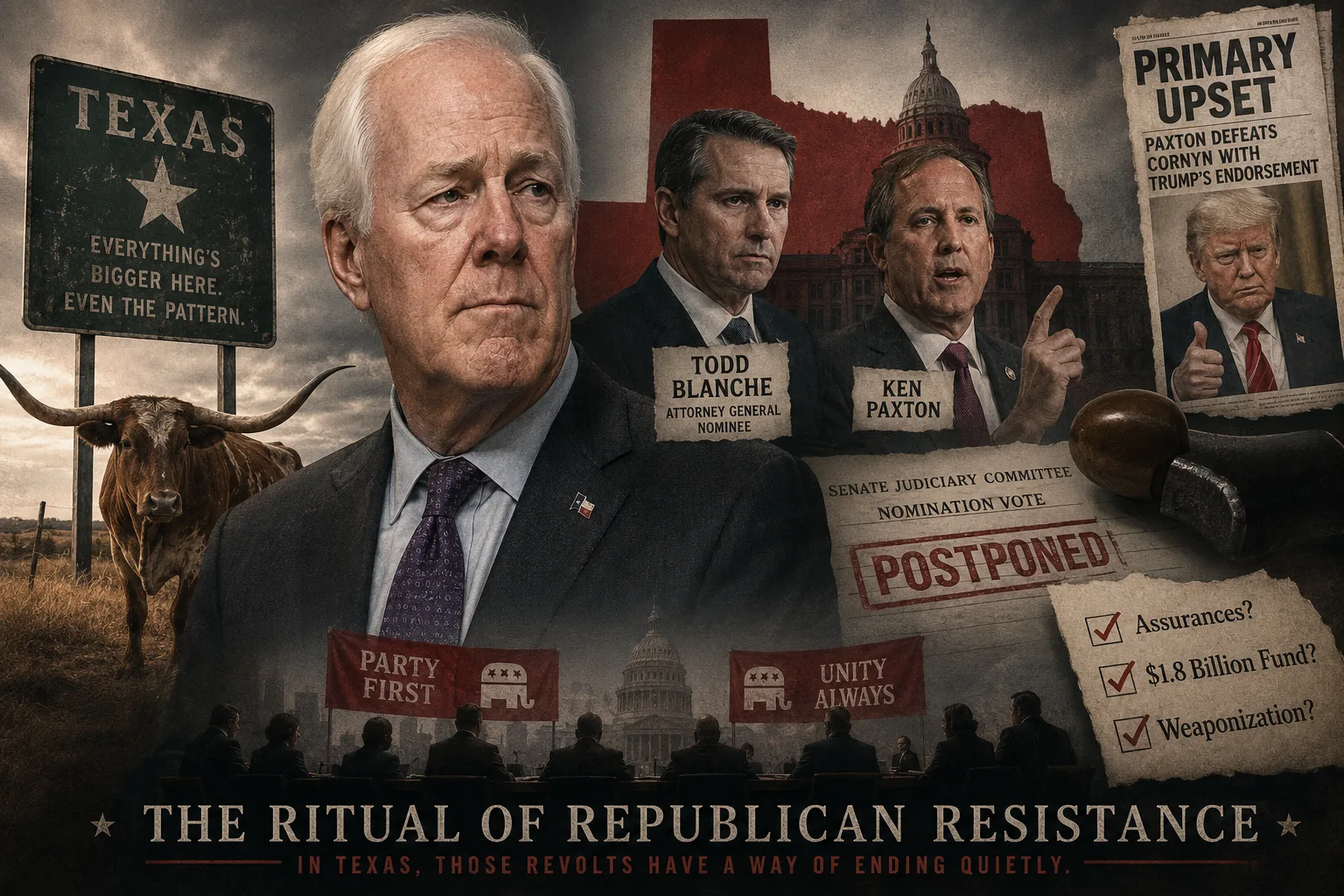
John Cornyn's resistance to Todd Blanche has the look of a Republican revolt. In Texas, those revolts have a way of ending quietly.
By R. Morales
Texas politics has a way of repeating itself.
Every election cycle, a handful of Republican lawmakers publicly distance themselves from a controversial nominee, criticize a party leader, or worry aloud about the direction of their own party. Headlines declare that Republicans are divided. Pundits ask whether this is finally the moment the cracks become too big to ignore.
Then the vote happens. More often than not, those same lawmakers fall back in line, party unity returns, and the controversy fades into the background. What looked like a rebellion turns out to have been a brief public disagreement on the way to a familiar outcome.
That pattern has become a defining feature of Texas politics. Republicans have held every statewide elected office in Texas for more than a quarter century. They have dominated the Legislature, shaped state policy, and held the governor’s office for decades. Yet when Texans talk about border security, public education, infrastructure, property taxes, or the economy, Democrats are often presented as the source of the trouble. It raises an obvious question: if Republicans have run the state for more than 25 years, why are Democrats still blamed for problems in a state Republicans govern?
The answer may have less to do with policy than with politics. As campaign season approaches, many Republican voters set aside controversies that generated outrage only months earlier. Disagreements inside the party matter less than defeating Democrats. Questions about ethics, contradictions, or internal conflict give way to broader ideological priorities.
No recent Texas politician demonstrates this better than Ken Paxton. He spent nearly a decade under indictment on securities fraud charges, which were eventually dropped under a pretrial agreement. The Texas House, run by his own party, impeached him over allegations that he abused his office; the Texas Senate acquitted him. His political future looked uncertain more than once.
None of it mattered at the ballot box. Republican voters kept nominating him. They reelected him statewide. Leaders who had criticized him ended up supporting him or working alongside him. And this May, Paxton completed the arc: carrying President Trump’s endorsement, he won nearly 64 percent of a primary runoff against John Cornyn, making Cornyn the first Republican senator from Texas ever denied his party’s nomination. Whether voters believed the allegations were politically motivated or simply cared more about Paxton’s conservative record, the result was the same. The controversies never translated into electoral defeat.
That history is what makes the drama around Todd Blanche’s nomination for attorney general so interesting. Cornyn says he is not prepared to vote yes, and on July 29 the Senate Judiciary Committee postponed its vote after he and Thom Tillis of North Carolina demanded written assurances that the Justice Department will not create a $1.8 billion fund to compensate people who say they were unfairly prosecuted during the Biden administration. The committee math gives the objection real teeth. Republicans hold 12 of the panel’s 22 seats, so a single Republican no vote deadlocks the nomination. For the moment, Cornyn is not posturing from the sidelines. He is the obstacle.
On its face, that sounds significant. And there is a wrinkle this time: Cornyn has already lost his primary. He owes Texas primary voters nothing and party leadership little. If ever a Texas Republican were free to follow through on his doubts, it is a senator with no election left to lose.
But Texas politics teaches caution before declaring a Republican revolt. Is Cornyn preparing a genuine break with his party, or is this political positioning on the way to voting yes? Nobody knows yet. History suggests a familiar script: express concern, create some distance, ask tough questions for the cameras, then bring the vote home when leadership needs it.
Perhaps this time will be different. Perhaps Cornyn will oppose the nomination and prove his concerns were more than theater. Or perhaps this becomes another chapter in a story Texans have seen many times, a brief moment of resistance followed by party unity when the final vote is called.
Texas itself may even be changing. Demographic shifts and increasingly competitive elections suggest the state is no longer the reliably deep red stronghold it once was. Democratic candidates keep gaining ground in urban and suburban counties, and every cycle produces predictions that Texas is on the verge of turning blue. Yet when Election Day arrives, Republicans keep finding a way to win statewide. The controversies fade. The disagreements become footnotes. The coalition holds.
That is why Cornyn’s comments are worth watching but not yet worth celebrating as evidence of a Republican fracture. Texas voters have seen this movie before. The speeches change. The headlines change. The controversy changes. But when the votes are counted, the ending often stays the same.